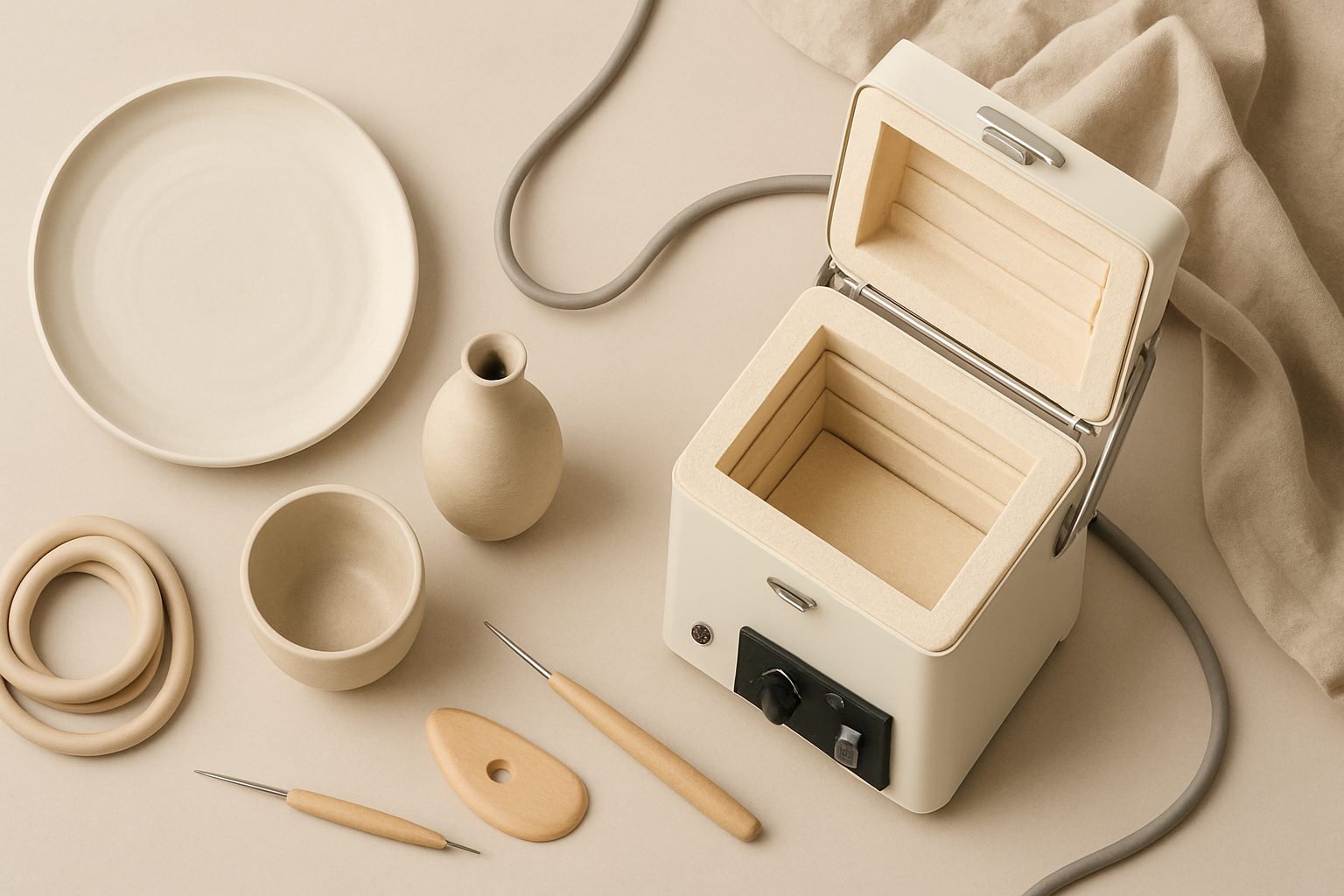
Best Kilns for Jewellery & Small Ceramics UK: Compact Firing Chambers Compared
Jewellery-making kilns aren't simply scaled-down pottery kilns. They solve a different problem: you need precise temperature control, rapid firing cycles, and a footprint that fits a bench or shelf in a workshop that probably doubles as a spare room. Whether you're working with precious metal clay (PMC), fusing glass, or firing ceramic beads and small sculptural pieces, the wrong kiln choice wastes money and time waiting for cool-downs.
This guide focuses on kilns under 10 litres—the working volume that makes sense for jewellery—and cuts through marketing claims to look at what actually matters on the UK market: voltage compatibility, real firing speeds, heat retention, and whether the kiln will survive years of regular use without creeping temperature drift.
Chamber size and what it means for your work
A 5-10 litre chamber is surprisingly generous for jewellery. PMC pieces fire at 600-900°C depending on type, and a small chamber reaches temperature quickly—typically 30-45 minutes from cold to 800°C if the insulation is decent. Compare that to a 30-litre pottery kiln, which might need 90+ minutes.
The actual usable volume is smaller than the advertised figure, because you need air circulation around pieces and cannot load the chamber edge-to-edge. A 7-litre kiln realistically holds about 15-20 small PMC pendants per firing, or a handful of larger ceramic sculptural pieces. That's enough for a small production schedule or serious hobbyist output.
Glass fusing demands tighter temperature control but benefits from the same rapid heat-up. Small kilns struggle less with temperature stratification (hot spots), so results across a shelf are more consistent.
UK voltage and heating element reality
UK workshops run on 230V single-phase supply. Most small jewellery kilns sold in the UK are rated at 13A or occasionally 16A (if you're running a dedicated circuit). This is important: a 3 kW kiln will pull maximum demand when heating and won't play nicely with other workshop equipment on the same circuit.
Check the actual element wattage, not just the maximum operating temperature. A kiln rated to 1200°C doesn't need 4 kW—that's overkill for jewellery work—but underpowered heating (under 1.5 kW) means slow ramps and patchy temperature. Aim for kilns in the 2-2.5 kW range for reliable performance without wiring headaches.
European kilns often come with euro plugs, which is annoying if they haven't been fitted with a British 13A plug before shipping. Budget £15-30 for a proper electrician to swap this over; don't attempt it yourself if you're unsure.
Insulation quality and heat retention
This is where cheap kilns really disappoint. Lightweight ceramic fibre insulation (the white, crumbly stuff lining the chamber) is standard, but thickness varies. A 5 cm wall keeps heat in; anything under 3 cm means excessive external surface temperature and energy waste.
Run your hand near the kiln during firing. You should feel warmth, not heat. If the exterior gets hot enough to be uncomfortable, the insulation is thin or badly applied. This matters for workshop safety and electricity costs—a poorly insulated kiln can push a 13A circuit close to its limit.
Kiln lids are a weak point. Single-layer lids lose heat rapidly. Better models use hinged ceramic-fibre lids with a solid backing board that reflect heat back into the chamber. Expect to feel significant warmth from the lid even with good design.
Firing speed and temperature control
PMC and glass work require controlled ramps—you can't just blast to temperature. Look for kilns with digital controllers that allow you to program ramp rates (in °C per hour). A typical PMC schedule is 300°C/hour to 900°C, hold 2 hours, cool naturally.
Mechanical thermostats are cheap but useless for this. They switch on and off at fixed setpoints and have no concept of ramp rate. You'll either overshoot temperature or spend forever reaching it. Digital controllers cost £150-300 extra but are essential.
Some kilns advertise "15 minutes to 1000°C," which sounds impressive but is usually the maximum ramp under no load. In reality, loading pieces slows heat-up (they absorb energy) and a safe ramp is slower. Realistic expectation: 30-45 minutes to working temperature, then 2-4 hours total cycle time including cooling.
Safety considerations for bench-top placement
Jewellery kilns get hot. The top surface can reach 150-200°C even with insulation. You need a heat-resistant shelf (tiles, metal mesh, or ceramic blocks underneath), at least 30 cm clearance from walls and combustible items, and proper ventilation.
Kilns don't vent gases the way open kilns do—some PMC firing releases organic binders and water. A small extractor fan or ducting to a window helps, especially in small rooms. This isn't a legal requirement, but the air quality difference is noticeable after a few hours of work.
Check for safety switches that cut power if the lid is lifted during high-temperature operation. Cheaper models skip this; it's a worthwhile safety feature.
Durability and element replacement
Kiln elements degrade over time. A heavy-use kiln (say, 50+ firings per year) might need a new element after 2-3 years. Find out whether your chosen model allows easy element replacement. Some kilns have the element wound into the chamber walls—replacement means professional service or writing off the kiln.
Better models have replaceable cartridge elements that slide in and out. Budget £100-150 for a replacement element; if the supplier charges double that, walk away.
Real expectations
A decent small jewellery kiln costs £400-800 new and will work reliably for years if you treat it right. Cheaper models exist but often have inconsistent temperature control or poor build quality that makes the saving false economy. Buy used if possible—a 5-year-old kiln from a closed workshop is often better value than a budget new one, and you can inspect the element condition first-hand.
More options
- Electric Pottery Kilns (Top-Loaders & Front-Loaders) (Amazon UK)
- Tabletop & Small Ceramic Kilns (Amazon UK)
- Kiln Furniture & Shelves (Amazon UK)
- Pyrometric Cones & Kiln Temperature Accessories (Amazon UK)
- Kiln Vent & Ventilation Systems (Amazon UK)