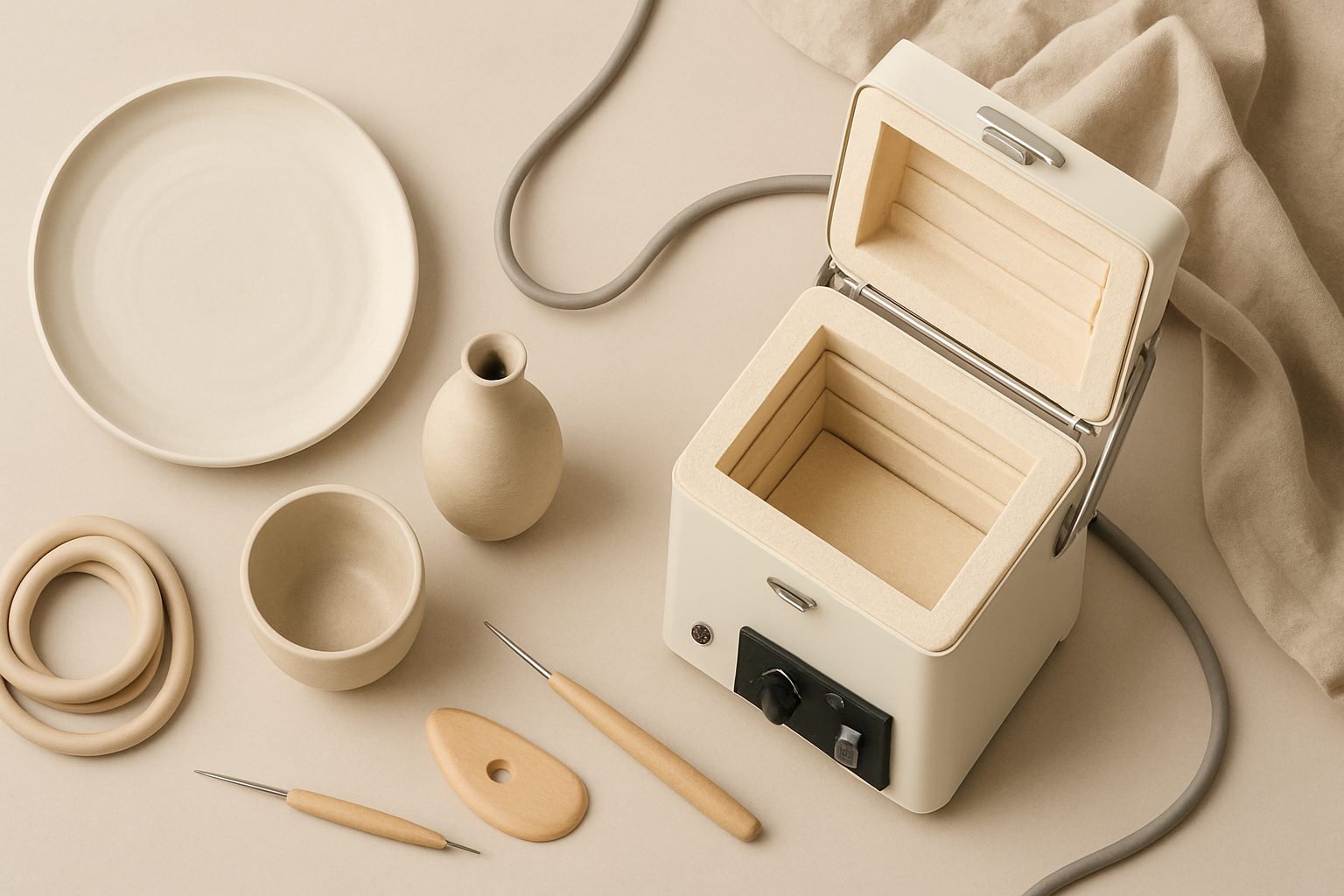
Best Small & Tabletop Pottery Kilns for Home Use UK (2026)
Pottery kilns don't need to dominate your studio. If you're working from a spare bedroom, garden shed, or kitchen extension, a compact kiln lets you fire work without major renovation or three-phase electrics. Tabletop and small floor-standing kilns under 20 litres work on a standard 13 A socket and heat up quickly—you're looking at realistic firing times rather than waiting all afternoon.
What Size Actually Means
When kiln makers say "capacity," they mean the usable chamber volume. A 10-litre kiln fits roughly four to five medium bowls or a dozen small pieces in one load, stacked carefully. You're limited by shelf space, not just raw volume. The actual footprint matters more than the spec sheet when you're fitting it into a corner.
Top-loading models (where you load from above) are more thermally efficient and reach temperature faster because heat doesn't escape sideways. Front-loading designs give you a clearer view of work inside and make removing larger pieces less of a contortion. Both work on domestic power.
Power and Space Reality
A 13 A circuit delivers 3 kilowatts maximum. Most compact electric kilns draw between 2.5 and 3 kW when firing—which means you can run one, but not a kettle or heater on the same circuit. Your kitchen ring main probably won't handle it if you're also using other appliances. A dedicated socket in your studio space is straightforward; an electrician can add one for under £150.
Brick kilns retain heat badly and need good insulation to be efficient. Modern compact kilns use fibre elements and lightweight ceramic fibre linings. They reach 1200°C in three to four hours from cold. Older or poorly insulated models might take twice as long and waste a third more power.
Top-Loaders vs Front-Loaders
Top-loaders are the efficiency champions. Heat rises, so the lid seals the chamber well. They're typically taller than they are wide—compact footprint, tall ceiling requirement. You'll need at least 700 mm headroom above the kiln to lift the lid fully. Loading and unloading requires bending and careful stacking, and removing a large pot mid-firing is awkward.
Front-loaders put the chamber on its side. They're wider but lower, fitting under shelves more easily. You see your work clearly and can rotate pieces mid-load without unstacking everything. The trade-off: they cool slightly faster because the front opening is larger, and you need clearance to swing the door open fully.
Ventilation Matters More Than Most Potters Expect
Even electric kilns release moisture, sulphur compounds, and kiln vapours during firing. A small spare room with no ventilation will develop a noticeable kiln smell within two or three firings. Passive ventilation—a vent brick near the kiln and a slightly open window—is enough. Forcing air directly onto the kiln during firing cools it and uses extra energy. Aim for gentle air movement, not circulation.
If your kiln sits in a garage or shed, ensure the space itself can breathe. A kiln crammed into a sealed corner heats the whole room and stresses the electrical circuit.
Key Dimensions for Planning
| Feature | Compact Top-Loader | Small Front-Loader | |---------|--------------------|--------------------| | Footprint | 450 × 450 mm | 600 × 450 mm | | Height | 600–700 mm | 500–550 mm | | Chamber depth | 300–350 mm | 250–300 mm | | Loaded capacity | 10–12 litres | 10–15 litres | | Heat-up time (cold) | 3–3.5 hours | 3.5–4 hours | | Cool-down (to handle) | 12–16 hours | 14–18 hours | | Power draw | 2.5–3 kW | 2.5–2.8 kW |
Stacking shelves inside is standard. A 300 mm deep top-loader typically takes one shelf comfortably; a 350 mm chamber takes two. Front-loaders are shallower, so you're usually working with two narrow shelves.
Temperature Consistency
Compact kilns have uneven temperature zones unless you rotate shelves or use wadding and kiln wash carefully. The hottest spot is usually centre-top in top-loaders and dead centre in front-loaders. Corners run 20–50°C cooler. Glaze melt is visible in the centre but underfired at edges: that's a real quirk of small chambers. Use thin stilts and leave space between pieces. Keep a diary of where each piece sits—you'll learn the kiln's personality within four or five firings.
Running Costs and Realism
A firing cycle—from cold to 1200°C, soak, cool to under 200°C—uses about 7–8 kilowatt-hours of electricity. At typical UK rates, that's £1.40–£1.60 per firing, assuming 25-minute heating, 30-minute soak, and natural cooling. If you fire twice a week, expect £12–£15 monthly in kiln power alone.
Shelves and stilts degrade. Budget replacement shelf sets every 80–120 firings; stilts last longer if you use kiln wash. Fibre elements stay good for 5–10 years with careful use.
The Practical Buy
Small kilns suit potters who fire little and often—experimentation, test batches, small commissions. They're not economical if you need to fire a dozen pieces weekly; a larger kiln spreads the running cost across more work. They excel for serious hobbyists and craft potters in tight spaces.
The honest limitation: you'll hit a skills ceiling eventually. Once you're confident and productive, the kiln's uneven temperature and low throughput become frustrating. That's not a fault of the kiln; it's a signal you're ready for the next step.
For now, a compact electric kiln on 13 A power solves the real problem—firing pottery at home without builder's consent or major expense. Measure your space, plan your ventilation, and expect to learn something new with every load.
More options
- Electric Pottery Kilns (Top-Loaders & Front-Loaders) (Amazon UK)
- Tabletop & Small Ceramic Kilns (Amazon UK)
- Kiln Furniture & Shelves (Amazon UK)
- Pyrometric Cones & Kiln Temperature Accessories (Amazon UK)
- Kiln Vent & Ventilation Systems (Amazon UK)