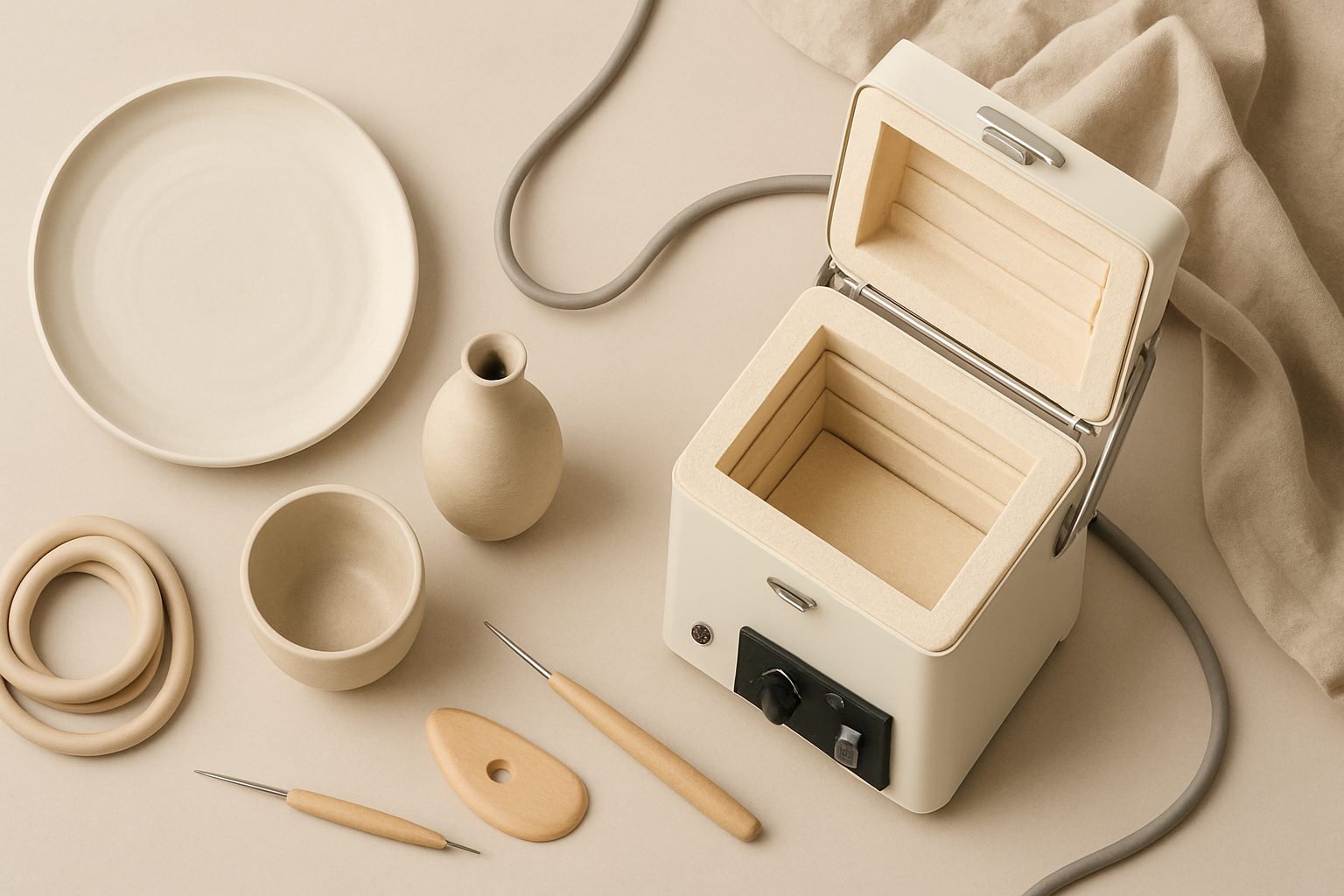
Pottery Kiln Temperature Guide for Beginners: Cones, Bisque & Glaze Firing Explained
If you're new to pottery and just bought your first kiln, temperature control is one of the most important things you'll need to understand. Firing clay at the wrong temperature can ruin your work—too cool and your glaze won't mature properly; too hot and your pot might slump or crack. But don't worry: temperature firing is manageable once you know what you're looking for.
Why Temperature Matters in Pottery
Every type of clay and glaze has a specific temperature range where it matures correctly. At lower temperatures, the clay remains porous and brittle. As heat increases, the clay particles fuse together and become stronger. Keep going and the glaze melts into a smooth, glass-like surface. Go too far and both clay and glaze can warp, bloat, or even fuse to the kiln shelf.
The temperature range that works for earthenware won't work for stoneware. The glaze you choose for one clay body might be completely wrong for another. That's why beginners need to match their clay, glaze, and kiln temperature all together—they're not independent choices.
Understanding Orton Cones
Orton cones are small pyramids made from ceramic materials designed to melt at specific temperatures. They're the most reliable way for a potter to know when firing is complete. Instead of trusting a kiln's built-in thermometer alone (which can be inaccurate), you place cones in your kiln where you can see them through a peephole, and you stop firing when the cone bends.
Each cone has a number: Cone 1, Cone 6, Cone 10, and so on. Higher numbers mean higher temperatures. The cone system accounts for both temperature and time—it's not just about reaching a peak temperature, but holding it long enough for the clay to vitrify properly. This is called "heat work."
For home pottery kiln users in the UK, you'll usually encounter:
- Cone 06–04: Low-fire earthenware (around 1000–1080°C)
- Cone 6: Mid-range stoneware and many studio clays (around 1220°C)
- Cone 10: High-fire stoneware and porcelain (around 1300°C)
Using cones correctly means placing at least two in your kiln (at different heights or positions) so you can be sure the temperature is even throughout.
Clay Types and Their Firing Temperatures
Earthenware
Earthenware is the softest and most porous clay body. It fires at the lowest temperatures, typically Cone 06 to Cone 04 (1000–1080°C). Earthenware stays porous even when fired—you can't drink from an unfired earthenware cup without the water seeping through. This means earthenware must be glazed if you want it to hold liquids.
Earthenware is forgiving for beginners because kilns fire quickly, costs are lower, and you can see results fast. The downside is that low-fire glazes can be fragile and some chip easily. Food-safe low-fire glazes also need careful selection, as some older recipes contain lead.
Stoneware
Stoneware fires between Cone 6 and Cone 10 (1220–1300°C). At these temperatures, the clay becomes fully vitrified—water can't pass through it anymore. Stoneware is much stronger than earthenware and feels more durable.
Cone 6 stoneware has become increasingly popular in UK studios because it's a good middle ground. It's stronger than earthenware, uses less fuel than Cone 10, and there's a huge range of Cone 6 glazes available. Cone 10 stoneware is traditional and beloved by many potters for its density and the subtle colour shifts some glazes show at higher temperatures, but it demands more from your kiln.
Porcelain
Porcelain also fires around Cone 6 to Cone 10, depending on the clay body. It becomes extremely hard and white, with a glass-like ring when you tap it. Porcelain is trickier for beginners because it's less forgiving during hand-building—it cracks more easily as it dries—but once fired successfully, it's beautiful and durable.
Bisque Firing vs. Glaze Firing
Most potters fire in two stages. The first is called a bisque fire (pronounced "bisk"), usually at Cone 04 to Cone 06 (around 1050°C). This fires the clay hard enough that it's no longer fragile, but it's still porous. Bisque ware can absorb water and glazes stick to it easily.
After bisqueing, you apply glaze and do a glaze fire at a higher temperature—Cone 6, Cone 10, or whatever matches your clay and glaze. The glaze melts and fuses to the clay surface, creating a waterproof, glass-like finish.
Firing twice sounds like extra work, but it's worth it. The bisque stage lets you check your work for cracks before investing time glazing, and porous bisque ware is much easier to glaze evenly.
Temperature Measurement: Thermometers vs. Cones
Most modern kilns have digital thermometers built in, which is helpful for tracking your firing curve. However, thermometers measure air temperature inside the kiln—not the actual heat work your pots are experiencing. This is why cones are still essential. A kiln might reach the right temperature but cool down too quickly, or heat unevenly, and a thermometer won't tell you that. A cone will.
For serious firing, many potters use both: a thermometer to monitor progress and guide the firing schedule, and cones as the final check for completion.
Getting Started: Temperature Basics
When you buy clay and glaze, always check the cone number. If your clay says "Cone 6," you need a kiln capable of firing to at least Cone 6, and your glaze must also be rated for Cone 6. Mixing incompatible clay and glaze temperatures causes problems—the glaze won't melt properly, or it'll run and stick to the kiln shelf.
Start with a clay body and glaze system designed for the same temperature, use cones every time you fire, and keep notes on how your kiln fires. Your kiln's personality—whether it fires hot in the back and cool in the front, for example—will become clear over time. Once you know your kiln, firing becomes much less mysterious.
More options
- Electric Pottery Kilns (Top-Loaders & Front-Loaders) (Amazon UK)
- Tabletop & Small Ceramic Kilns (Amazon UK)
- Kiln Furniture & Shelves (Amazon UK)
- Pyrometric Cones & Kiln Temperature Accessories (Amazon UK)
- Kiln Vent & Ventilation Systems (Amazon UK)